
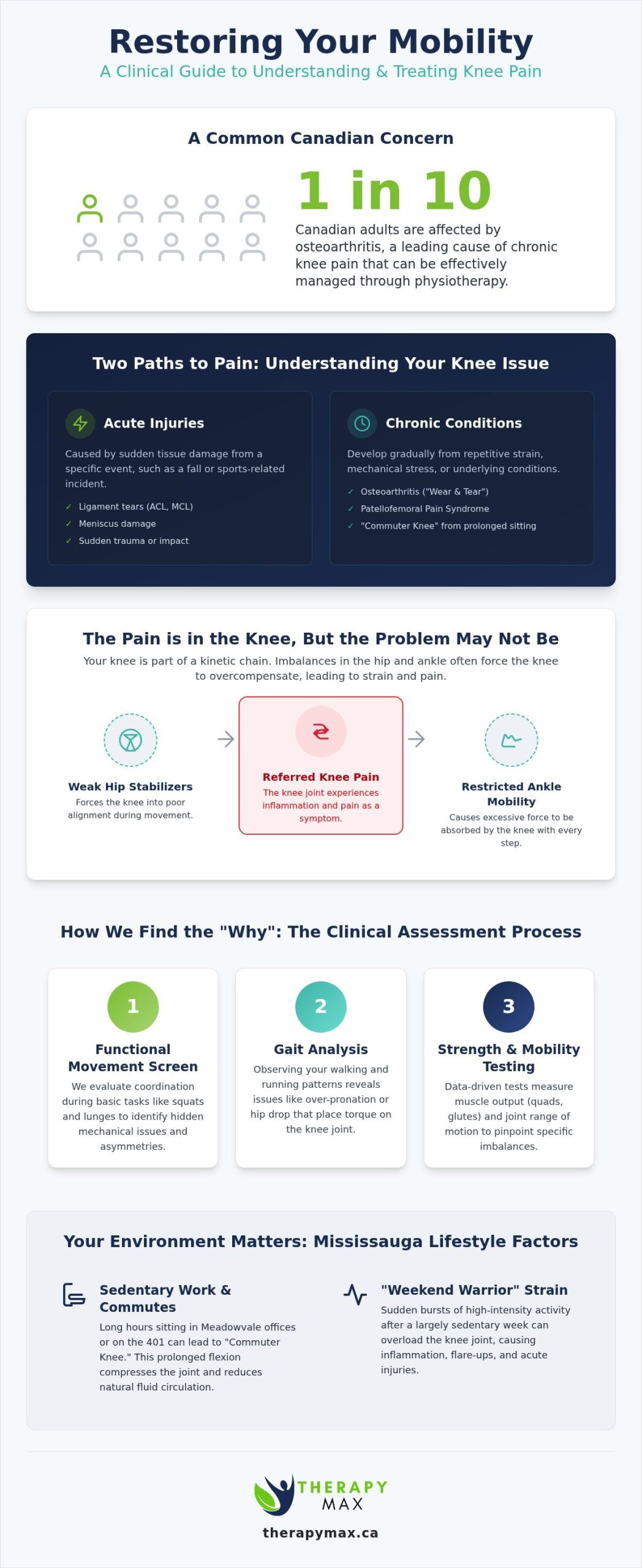
Imagine finishing a long commute on the 401 only to find your knee has locked into a stiff, aching position before you even reach your front door in Meadowvale. It’s frustrating when a simple walk through Lake Aquitaine Park or climbing the stairs at home becomes a source of sharp, unpredictable pain. You aren’t alone in this struggle. Current data indicates that 1 in 10 Canadian adults are affected by osteoarthritis, and many others face mechanical issues that limit their daily freedom.
You may fear that these persistent clicks and aches signal the end of your active lifestyle. However, professional physiotherapy for knee pain Mississauga residents trust can resolve the root cause of your discomfort and restore your mobility without the need for surgery. This clinical guide explains how a functional realignment of the entire lower limb can stabilize your joint and alleviate pressure. We will preview the evidence-based assessment techniques and non-invasive treatments used to move you from a state of stiffness toward a life of fluid, pain-free movement.
Key Takeaways
- Understand the distinction between acute tissue tears and chronic wear caused by mechanical stress to better manage your recovery journey.
- Discover how a professional functional movement screen identifies hidden issues, such as restricted ankle mobility, that often lead to knee instability.
- Learn how targeted manual therapy and specialized physiotherapy for knee pain Mississauga can strengthen your joint’s supporting cast to avoid surgical intervention.
- Explore the benefits of an integrated care model that combines physiotherapy with manual osteopathy to ensure proper limb alignment and long-term health.
- Gain practical strategies for ergonomic driving on the 401 and office setups to protect your knees from daily strain and prevent future re-injury.
Understanding Knee Pain: Why Your Joint is Aching
Knee pain is rarely a random occurrence; it is a biological signal that your joint is experiencing mechanical stress or tissue inflammation. When the physical load on your joint exceeds its capacity to recover, the body triggers a pain response to prevent further damage. Understanding What is physiotherapy helps many patients realize that clinical recovery is not just about silencing the pain. It involves restoring the mechanical balance of the entire limb. Professional physiotherapy for knee pain Mississauga residents rely on focuses on this balance to ensure the joint can handle the demands of daily life.
We generally categorize knee issues into two main groups. Acute injuries involve sudden tissue damage, such as a ligament tear during a sports match. Chronic conditions are different. These involve a gradual “wear and tear” process where the joint tissues degrade over time due to repetitive strain. In Mississauga, we frequently see a specific type of chronic strain known as “Commuter Knee.” Long hours spent idling in traffic on the 401 or the QEW keep the knee in a fixed, flexed position. This posture compresses the patella and limits the natural circulation of joint fluid. Over time, this leads to a dull, persistent ache that is often mistaken for simple tiredness.
It is also vital to recognize that your knee does not work in isolation. It is a hinge joint caught between the hip and the ankle. Sometimes, the pain you feel in the knee is actually referred pain from a stiff lower back or weak hip stabilizers. If the muscles around your pelvis aren’t doing their job, your knee is forced to overcompensate, leading to inflammation that won’t go away until the “root cause” is addressed.
Common Causes of Knee Discomfort
Several clinical conditions frequently lead to joint distress. Patellofemoral Pain Syndrome, often called “Runner’s Knee,” occurs when the kneecap does not track smoothly within its groove. Osteoarthritis is another common reality, affecting 1 in 10 Canadian adults. It involves the thinning of protective cartilage, but it can be managed effectively through movement. We also treat many ligament and meniscus strains. Whether it is the ACL, MCL, or PCL, these structures provide the essential stability your knee needs to function without clicking or giving way.
The Mississauga Lifestyle and Knee Health
Local lifestyle factors play a significant role in joint health. Many people working in Meadowvale offices spend eight hours a day seated, which causes the knee’s natural lubrication to stagnate. This lack of movement makes the joint feel “rusty” when you finally stand up. Additionally, the walking surfaces in our local parks can be unforgiving if your footwear lacks proper support. We often see “weekend warriors” who are sedentary all week but then engage in high-intensity activities on Saturday. This sudden spike in activity without progressive loading is a primary cause of sudden knee flare-ups.
The Clinical Assessment: How Physiotherapy Identifies the Root Cause
A clinical assessment is a detailed investigation into the mechanics of your body. It moves beyond simply identifying where it hurts to understanding why the pain began in the first place. When you seek physiotherapy for knee pain Mississauga practitioners often begin with a functional movement screen. This process evaluates how your joints and muscles coordinate during basic tasks like squatting, lunging, or stepping. It is during these screens that we often realize the connection between restricted ankle mobility and knee instability. If your ankle cannot flex properly, your knee is forced to absorb excessive force with every step you take on the pavement.
Our practitioners also utilize gait analysis to observe your movement patterns while walking or running. This allows us to see if your foot over-pronates or if your hips drop, both of which place unnecessary torque on the knee joint. We combine these observations with objective strength testing. By measuring the output of your quadriceps, hamstrings, and glutes, we can identify specific muscle imbalances that contribute to joint misalignment. This data-driven approach ensures that your treatment plan is based on your unique physiological needs rather than a generic protocol.
What to Expect During Your Initial Visit
Your first session begins with a detailed review of your medical history and any previous injury patterns. We want to understand the context of your pain, including how your daily habits might be contributing to the issue. A professional clinical assessment for knee pain also involves physical palpation to locate precise areas of tenderness, heat, or swelling. Finally, we conduct range of motion testing to set a clear baseline for your recovery. This allows us to track your progress accurately as your joint begins to move more freely.
Setting Realistic Recovery Goals
Recovery is a collaborative process between the practitioner and the patient. We work with you to develop a specific timeline for pain reduction and a return to your normal daily activities. We understand that Mississauga residents have busy lives; therefore, we organize a treatment plan that respects your work schedule and personal commitments. This partnership ensures that your recovery goals are both achievable and sustainable. If you are ready to uncover the source of your discomfort, you can schedule a comprehensive evaluation with our clinical team to begin your journey back to full mobility.
Physiotherapy Modalities for Knee Pain Relief
Effective recovery from joint discomfort requires more than just resting the limb. It involves a strategic combination of clinical modalities designed to restore function and reduce inflammation. When you undergo physiotherapy for knee pain Mississauga clinicians select specific tools based on your assessment data. These modalities work together to address the mechanical restrictions in your joint and the tension in your surrounding muscles. By changing how the joint functions rather than just masking the symptoms, we create a path toward long-term relief.
Soft tissue release is a vital component of this process. We often find that muscles like the hamstrings, calves, or the iliotibial (IT) band become excessively tight as they try to protect a painful knee. This tension can actually pull the kneecap out of its proper track. By releasing these tissues, we normalize the tension across the joint. For those who need immediate support during their recovery, we may also utilize bracing or kinesiology taping. These are temporary mechanisms that provide sensory feedback to your brain, helping you feel more stable while you build the strength necessary to support the joint on your own.
Manual Therapy and Joint Mobilization
Hands-on techniques involve the practitioner applying precise pressure to glide the joint surfaces. This process improves the circulation of synovial fluid, which acts as a natural lubricant for your cartilage. By reducing joint stiffness through mobilization, we create a window where you can move with less discomfort. This clinical approach often pairs well with Therapeutic Massage Mississauga to address both joint mechanics and soft tissue restrictions simultaneously.
Targeted Strengthening Exercises
Specific joint issues require more than just general activity like walking. We focus on the “supporting cast” of the knee, particularly the VMO and gluteus medius, which ensure proper kneecap tracking. We provide patients with structured Knee conditioning exercises that are easy to integrate into a daily routine. These programs move beyond basic fitness to focus on the technical precision of muscle engagement, ensuring your joint is protected during higher-impact activities in Mississauga’s parks or gyms.
The TherapyMax Advantage: Integrated Care for Knee Health
Knee recovery is most effective when it addresses the body as an interconnected system. At TherapyMax, we utilize an integrated care model where Physiotherapy Mississauga specialists collaborate directly with other on-site practitioners. This multidisciplinary approach ensures that every aspect of your joint health is considered. While a physiotherapist focuses on strengthening and mechanics, a manual osteopath might address the structural alignment of your pelvis to reduce uneven loading on the knee. This internal communication between experts eliminates the guesswork for the patient. It creates a seamless transition between different phases of healing.
When you choose physiotherapy for knee pain Mississauga at a clinic with multiple disciplines, you benefit from a shared clinical perspective. Our team meets to discuss your progress and adjust your treatment plan in real-time. This ensures that your massage therapy sessions support your physiotherapy goals and that your osteopathic adjustments enhance your overall stability. Having your entire recovery team under one roof saves you time and ensures a higher standard of cohesive care. This model supports long-term wellness rather than providing a temporary fix.
Osteopathy for Knee Realignment
Our practitioners often find that knee pain is the result of a “global kinetic chain” issue. For example, a subtle pelvic tilt can cause one leg to rotate slightly inward, placing immense stress on the medial aspect of the knee. Manual Osteopathy addresses these structural imbalances by gently realigning the body’s framework. This whole-body expertise is a hallmark of our clinic, whether we are treating joints or providing Osteopathy for Neck Pain. By correcting the foundation of your posture, we ensure your knees are no longer forced to overcompensate for issues elsewhere in your skeleton.
Massage Therapy as a Recovery Catalyst
Registered Massage Therapy (RMT) serves as an essential partner in the rehabilitation process. We use Swedish Massage to manage systemic inflammation and improve overall tissue recovery. For chronic issues like IT band friction, deep tissue techniques help to break down adhesions that restrict the knee’s range of motion. RMT care is essential for maintaining tissue health between your physiotherapy sessions. It reduces the compensatory pain that often develops in the quads and calves when you change how you walk during recovery. If you are ready to experience the benefits of a collaborative health team, you can book your integrated assessment today to receive a personalized recovery roadmap.
Long-Term Prevention: Keeping Your Knees Healthy in Mississauga
Recovery doesn’t end when the sharp pain disappears. Many patients fall into a “fear-avoidance” cycle where they stop active movement because they worry about re-injury. This inactivity actually leads to further muscle wasting and joint stiffness. To break this cycle, we focus on building knee resilience. Knee resilience is the ability of the joint to handle unexpected load. Achieving this state requires a transition from clinical treatment to a lifestyle of proactive maintenance. Regular physiotherapy for knee pain Mississauga residents receive at our Meadowvale clinic acts as a “tune-up” to catch minor mechanical shifts before they become major setbacks.
Progressive loading is the cornerstone of preventing future issues. Once your initial inflammation has subsided, your physiotherapist will gradually increase the weight and complexity of your exercises. This process ensures that your tendons and ligaments are strong enough to support your joint during high-impact activities. By slowly challenging the joint in a controlled environment, we prepare your body for the unpredictable stresses of daily life.
Ergonomics for the Mississauga Commuter
Your environment plays a significant role in your joint health. If you spend significant time driving on the 401 or the QEW, adjust your car seat so your hips are slightly higher than your knees. This position reduces the constant flexion strain on the patella. We also recommend “movement snacks” during the workday. If you work in a Meadowvale office, stand up and perform gentle heel raises or seated leg extensions every 30 minutes to encourage joint lubrication. Additionally, ensure your footwear provides adequate arch support for the varied terrain in local parks. Proper support at the ground level prevents your knee from collapsing inward during your stride.
Returning to Sport and Active Living
When you return to your favourite activities, follow the “10% rule.” This means you shouldn’t increase your activity duration or intensity by more than 10% per week. This progressive loading allows your tissues to adapt to the new stress without inflaming the joint. It’s also important to distinguish between “good” and “bad” pain. Muscle soreness after a workout is a sign of adaptation. However, sharp, stabbing, or localized joint pain is a signal to slow down. We encourage you to maintain the progress you’ve made by staying consistent with your home exercise program. Your journey to lasting mobility is a partnership, and we remain a safe harbour for your long-term physical harmony.
Reclaiming Your Active Lifestyle
Recovering from joint discomfort is a methodical process that begins with identifying the precise mechanical root cause of your pain. We have explored how a clinical assessment moves beyond surface-level symptoms to address imbalances in the kinetic chain. By combining manual therapy with targeted strengthening and progressive loading, you can move past the fear of re-injury. This evidence-based approach ensures that your recovery is sustainable and fits naturally into your daily routine.
Our team of Registered Physiotherapists at our multidisciplinary Meadowvale location is committed to restoring your physical harmony through personalized care. Opting for professional physiotherapy for knee pain Mississauga provides you with a reliable, non-invasive path toward lasting mobility. You deserve to walk through our local parks and manage your daily tasks without the limitation of a clicking or aching joint. Book your knee assessment at our Mississauga clinic today. We look forward to partnering with you on your journey toward better health and a more vibrant, active life.
Frequently Asked Questions
How many physiotherapy sessions will I need for my knee pain?
The number of sessions depends on whether your condition is an acute injury or a chronic mechanical issue. Most patients require an initial plan of four to eight weeks, with visits occurring once or twice per week. Your physiotherapist will establish a specific timeline after your assessment and will adjust your visits based on how quickly your joint recovers its function.
Do I need a doctor referral to see a physiotherapist in Mississauga?
You don’t need a referral from a physician to access physiotherapy in Ontario because physiotherapists are primary healthcare professionals. You can book an appointment directly to begin your recovery. However, it’s a good idea to check your private insurance policy, as some extended health plans require a doctor’s note before they will reimburse you for the cost of treatment.
Can physiotherapy help with knee arthritis?
Physiotherapy is a highly recommended first-line treatment for knee arthritis because it focuses on strengthening the muscles that support the joint. By improving the function of your quadriceps and glutes, we reduce the mechanical pressure on the arthritic surfaces. This approach helps to manage pain and maintain your mobility, which can often delay the need for surgical interventions.
Is it better to use heat or ice for my knee pain?
Use ice for acute injuries or sudden flare-ups that involve swelling, redness, and heat. Applying an ice pack for 15 minutes helps to constrict blood vessels and reduce inflammation. Use heat for chronic stiffness or muscle aches to improve blood flow and relax tight tissues. If your knee feels “rusty” after a long commute, heat is often the more effective choice for relief.
Will I have to do exercises at home?
Home exercises are a critical component of your recovery because they reinforce the mechanical changes made during your clinical visits. We provide you with a structured program that focuses on technical precision and takes only a few minutes each day. These movements ensure that your muscles continue to adapt and support your joint while you are away from the clinic.
Is physiotherapy for knee pain covered by insurance in Ontario?
Most extended health insurance plans in Ontario provide coverage for physiotherapy for knee pain Mississauga residents receive. Since the profession is regulated by the College of Physiotherapists of Ontario, services are recognized by major insurance providers. You should review your specific benefits package to determine your annual coverage limits and whether your plan allows for direct billing.
Can I continue to exercise while receiving treatment?
You can usually remain active, but we will likely modify your current routine to protect the joint during the healing phase. Total rest often leads to muscle weakness, so we prefer to keep you moving in ways that don’t aggravate your symptoms. We will help you identify which activities in your local gym or park are safe and which ones you should temporarily avoid.
How is physiotherapy different from chiropractic care for knees?
Physiotherapy focuses on restoring functional movement through a combination of manual therapy, soft tissue release, and therapeutic exercise. While chiropractic care often emphasizes joint adjustments, our approach prioritizes the “supporting cast” of the knee and the realignment of the entire lower limb. We aim to improve the way your body moves as a whole to prevent the pain from returning.
