

Did you know that as many as 40% of individuals will experience the debilitating effects of sciatica at some point in their lives? If you’re currently struggling with sharp, shooting pain that makes sitting unbearable or keeps you awake at night, you’re certainly not alone. It’s frustrating when simple movements like walking become a challenge. It’s even more confusing when you aren’t sure whether you should see a physiotherapist, a massage therapist, or an osteopath to address the radiating discomfort.
Finding effective sciatica treatment Mississauga starts with understanding that your pain is a signal of nerve compression that requires professional, evidence-based care. We know that true recovery involves more than just masking the symptoms; it requires a clinical approach to identify the root cause and restore your body’s physical harmony. This guide explores the most effective clinical treatments available to help you return to your favourite hobbies. We will outline how a multi-disciplinary approach can reduce your pain and provide you with a clear, personalized recovery plan for lasting relief.
Key Takeaways
- Understand that sciatica is a symptom of nerve compression rather than a standalone condition, following a specific path from your lower spine down to your feet.
- Discover why an integrated approach to sciatica treatment Mississauga patients rely on combines physiotherapy, massage, and manual osteopathy to restore mechanical function.
- Learn to distinguish between common causes of nerve pressure, such as bulging discs or spinal stenosis, to ensure your recovery plan is truly personalized.
- Master a step-by-step emergency protocol for the first 24 hours of a flare-up, including the correct way to use ice and heat for nerve inflammation.
- Realize the importance of a root-cause assessment in a regulated clinical setting to achieve lasting relief and a safe return to your daily activities.
What is Sciatica? Understanding the Path of Nerve Pain
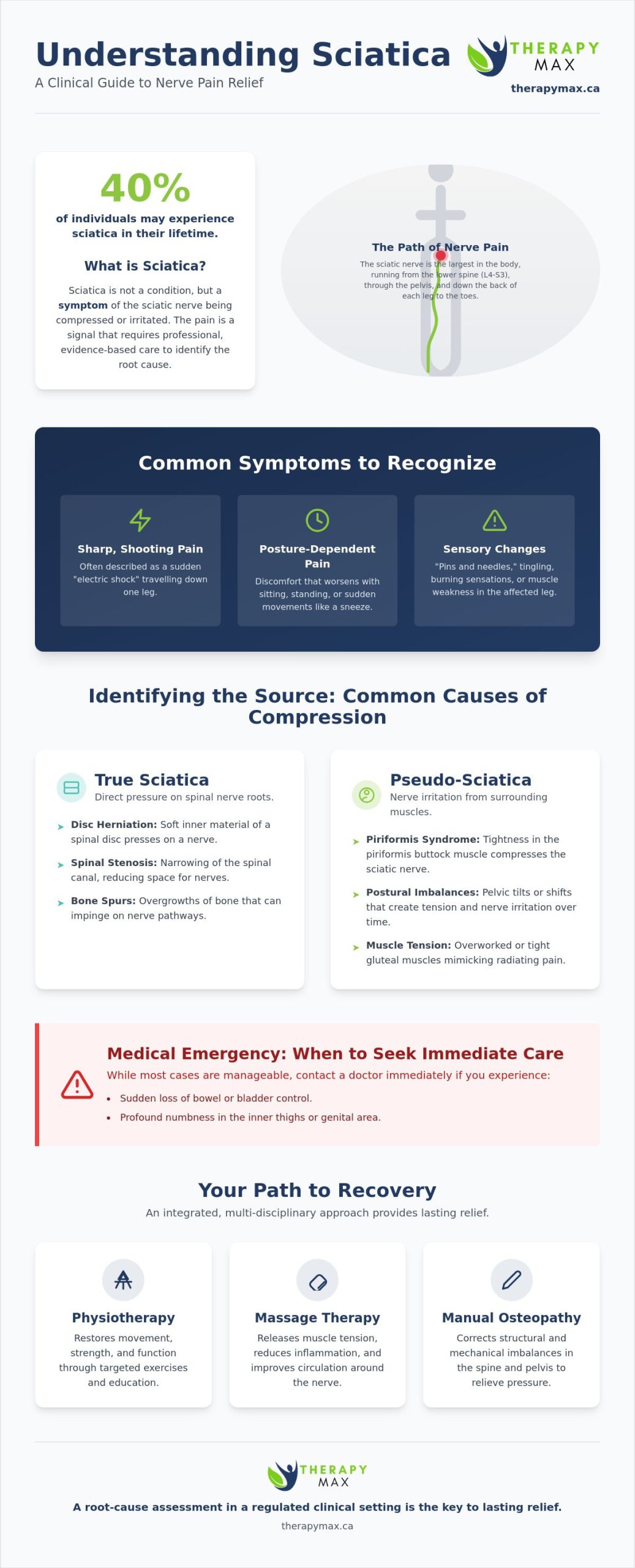
Many people assume that sciatica is a specific medical diagnosis. In reality, it’s a descriptive term for a set of symptoms that occur when the sciatic nerve is irritated or compressed. To truly understand what is sciatica, we must look at the complex network of nerves in your lower spine. This nerve is the largest in the human body, measuring roughly the width of a thumb at its thickest point. It originates from the L4 to S3 vertebrae in your lumbar and sacral spine. From this starting point, it weaves through your pelvis and travels down the back of each leg all the way to your toes.
When this delicate pathway is disrupted, the resulting sensations are often quite intense. Patients frequently describe the pain as a sudden electric shock that travels down the thigh. You might also experience a persistent “pins and needles” tingling or a sensation that your leg feels heavy and difficult to lift. These symptoms occur because the nerve’s ability to transmit electrical signals is compromised. Identifying whether these symptoms originate in the spine or the muscles is a core component of effective sciatica treatment Mississauga practitioners provide to ensure long-term recovery.
We also differentiate between true sciatica and pseudo-sciatica. True sciatica involves direct pressure on the nerve roots at the spinal level, often caused by structural changes in the vertebrae. Pseudo-sciatica, on the other hand, is frequently caused by muscle tension in the glutes, such as piriformis syndrome, which mimics the radiating pain of a spinal issue. Both can be significantly painful, but the clinical approach to treating them differs because the root cause is located in different physiological systems.
Common Symptoms to Recognize
Sciatica typically presents in a very specific manner that sets it apart from standard back strain. It’s almost always unilateral, meaning you’ll only feel the sharp sensations on one side of your body at a time. The pain often behaves like a “moving” discomfort that shifts depending on your posture. You might find that sitting at a desk for an hour makes the shooting pains worse, or that a simple sneeze triggers a sharp jolt. In some cases, you may notice a burning sensation deep in the buttock or weakness in your foot that affects how you walk.
When Sciatica Becomes a Medical Emergency
While the pain can be severe, most cases don’t require surgical intervention. However, there are specific “red flag” symptoms that shouldn’t be ignored. If you experience a sudden loss of bowel or bladder control, or if you notice profound numbness in your inner thighs, please seek immediate medical attention. These symptoms can indicate a rare condition that requires urgent care. For the vast majority of our neighbours, professional sciatica treatment Mississauga offers a safe, conservative path to recovery. Our goal is to use evidence-based therapies to relieve pressure on the nerve and help you return to your daily routine with confidence.
Identifying the Source: Common Causes of Sciatic Nerve Compression
Effective sciatica treatment Mississauga residents seek often begins with a precise mechanical assessment. While the pain feels like it’s in the leg, the source is usually located much higher in the body. A problem with the sciatic nerve is frequently the result of structural changes in the lumbar spine. For instance, when a spinal disc bulges or herniates, its inner material can press directly against the nerve roots. This mechanical pressure triggers the inflammatory response that causes radiating pain. Beyond discs, degenerative changes like bone spurs can also narrow the pathways where nerves exit the spine.
Postural habits play a significant role in nerve tension. Pelvic tilts and imbalances in the kinetic chain can create a ripple effect that increases pressure on the lower back. Even conditions like Upper Cross Syndrome, which involves rounded shoulders and a forward head posture, can lead to compensatory shifts in the pelvis. These shifts often cause the lower back to over-arch, which irritates the sciatic nerve over time. These imbalances often develop from repetitive movements or prolonged static positions, making a thorough physical assessment essential for recovery.
Disc Herniation vs. Spinal Stenosis
A disc herniation occurs when the soft centre of a spinal disc pushes through a tear in the tougher exterior. In contrast, spinal stenosis is a structural narrowing. Spinal stenosis is the age-related narrowing of the spaces within your spine. These two conditions often respond differently to movement. Patients with stenosis often find relief when leaning forward, as this position temporarily opens the spinal canal and reduces pressure. Those with a herniated disc may find that specific bending movements increase their sharp, shooting symptoms. Distinguishing between these mechanical causes is a core part of the professional care we provide to our Mississauga neighbours.
The Piriformis Syndrome Connection
Not all sciatic pain originates in the spine. The piriformis muscle, located deep in the buttock, sits directly over the sciatic nerve. If this muscle becomes tight or spasms, it can trap the nerve and mimic the symptoms of a spinal issue. This is a common occurrence for Mississauga commuters and office workers who spend long hours sitting in traffic or at a desk. Constant pressure on the gluteal region can cause the piriformis to shorten and irritate the nerve. Specialized massage therapy can help release this compression point and restore physical harmony. If you are struggling with these symptoms, you can book a clinical assessment to find the exact source of your discomfort and start your journey toward sciatica treatment Mississauga patients trust for lasting relief.
Clinical Treatment Options in Mississauga: Physio, Massage, and Osteopathy
Many patients feel overwhelmed when deciding which healthcare professional to visit for nerve pain. While some clinics treat physiotherapy, massage, and osteopathy as separate silos, we utilize an Integrated Recovery model. This approach ensures that your treatment plan addresses the mechanical, muscular, and structural components of your condition simultaneously. By combining these disciplines under one roof, we provide a more cohesive experience for sciatica treatment Mississauga residents can rely on for sustainable results.
Understanding the Common Causes of Sciatic Nerve Compression is the first step toward choosing the right therapeutic path. If a herniated disc is the primary issue, your recovery requires a different focus than if your pain stems from pelvic misalignment. Our practitioners work together to ensure that each technique builds upon the last, moving you from acute pain relief toward functional independence.
Physiotherapy for Long-Term Functional Recovery
Physiotherapy is the cornerstone of restoring mechanical function and strength. When you visit a physiotherapist in Mississauga, the focus is on decompressing the nerve through specific, evidence-based movements. Your therapist will design a personalized exercise program to improve your mobility and build a resilient core. We often use modalities like TENS or heat therapy to modulate pain in the early stages, allowing you to participate more comfortably in your rehabilitation. This proactive approach helps stabilize the spine and prevents future recurrences of nerve irritation. The same evidence-based physiotherapy principles that guide sciatica recovery also apply to other musculoskeletal conditions, as explored in our guide to physiotherapy for shoulder pain Mississauga residents commonly experience alongside spinal issues.
The Role of Manual Osteopathy in Structural Balance
Manual Osteopathy offers a unique, holistic perspective on nerve health by focusing on how the whole body’s structure affects the sciatic nerve. Rather than just looking at the lower back, an osteopath examines the relationship between the pelvis, hips, and spine. We use gentle mobilization techniques to improve joint play and facilitate better nerve gliding. This “whole-body” approach contrasts with localized treatments by ensuring that the entire physical system is in harmony. By realigning the structural foundation of the body, we create an environment where the nerve can heal without constant mechanical interference.
Massage Therapy: More Than Just Relaxation
Registered Massage Therapy (RMT) plays a vital role in reducing protective muscle guarding. When you are in pain, your muscles often tighten as a defence mechanism, which can actually increase pressure on the sciatic nerve. Clinical deep tissue work can reach the deep rotators of the hip to release this secondary compression. Beyond the physical benefits, the nurturing aspect of massage helps lower the body’s overall pain response by calming the nervous system. For those seeking a broader context for wellness, our Swedish Massage Mississauga guide explains how these techniques support general recovery. Integrating massage into your sciatica treatment Mississauga plan helps soothe the soft tissues while other therapies address the underlying structural issues.
Managing Sciatica Flare-ups: Practical Strategies and Prevention
A sciatica flare-up can be an overwhelming experience that disrupts your daily routine without warning. When the sharp, radiating pain returns, your immediate goal is to calm the nervous system and reduce acute inflammation. Roughly 50% of sciatica cases resolve within six weeks with proper management, but the first 24 hours are critical for setting the stage for recovery. We recommend a three-step Emergency Protocol to manage the initial onset of symptoms:
- Prioritize Relative Rest: Avoid complete bed rest, as total inactivity can lead to muscle stiffness. Instead, find a comfortable position that reduces nerve tension and limit your activity to short, gentle walks.
- Apply Ice for Inflammation: Use a cold pack on your lower back for 15 minutes every two to three hours. Ice is generally preferred over heat during the first 48 to 72 hours because it helps constrict blood vessels and reduces the chemical inflammation around the nerve root.
- Monitor Your Movements: Avoid heavy lifting, twisting, or prolonged sitting. These actions increase intradiscal pressure and can aggravate the compression.
While ice manages the initial chemical irritation, heat can be beneficial once the acute phase passes. Heat helps relax the “protective guarding” in the muscles we discussed in the previous section. If your symptoms persist beyond the first few days, seeking professional sciatica treatment Mississauga practitioners provide will ensure you receive a clear, evidence-based plan to move past the flare-up safely.
Ergonomics for the Mississauga Professional
Many of our clients work in the Meadowvale business hub or endure long commutes on the 401 and 407. Prolonged sitting is often the primary trigger for nerve tension. Slumping in your chair creates a posterior pelvic tilt, which puts significant pressure on the lumbar discs. To prevent strain, ensure your monitor is at eye level and your feet are flat on the floor. A dedicated lumbar support cushion can help maintain the natural curve of your spine. We also suggest setting a timer for “micro-breaks” every 30 minutes to stand and reset your posture.
Nerve Gliding: The ‘Flossing’ Technique for Relief
Nerve gliding is a gentle exercise technique designed to restore smooth movement to an entrapped nerve. Unlike traditional muscle stretching, nerve “flossing” involves moving the nerve back and forth through its soft tissue sheath. This helps reduce adhesions and improves the nerve’s blood supply. You can try a simple seated version by extending your affected leg and slowly flexing your ankle while gently tilting your head back. Stop immediately if you feel an increase in sharp pain or tingling. If you are unsure how to perform these movements correctly, book a consultation with our clinical team to receive a supervised sciatica treatment Mississauga plan tailored to your specific mobility needs.
Why Choose TherapyMax for Sciatica Recovery in Mississauga
Choosing the right clinical environment for sciatica treatment Mississauga can feel like a significant decision, especially when you are in constant discomfort. At TherapyMax, we position ourselves as the Meadowvale experts in multi-disciplinary nerve care. Our “Nurturing Expert” philosophy means we prioritize the individual sitting in front of us rather than just focusing on an MRI scan or an X-ray report. We understand that while two people may have the same spinal findings, their experience of pain and their path to physical harmony will be entirely unique. Our regulated medical environment provides the technical precision you need, balanced with the patient-centered warmth you deserve.
We offer specialized treatments that go beyond standard rehabilitation. For those whose nervous systems are in a state of high alert due to chronic pain, we provide Ayurvedic massage to facilitate deep relaxation and soothing. This holistic approach helps calm the sciatic nerve by reducing systemic stress, which often amplifies pain signals. By integrating these specialized wellness traditions with evidence-based physiotherapy and osteopathy, we create a safe harbour for both your recovery and your peace of mind.
A Personalized Path to Healing
Your journey begins with a comprehensive initial assessment where we work to identify your specific root cause. We don’t believe in quick fixes that only mask symptoms for a few days. Instead, our practitioners develop a structured plan that evolves as you progress. We encourage open communication and adjust your treatment based on your feedback and how your body responds to specific techniques. This methodical approach ensures that we are always moving toward long-term wellness and functional independence. Whether we are utilizing manual osteopathy to realign your pelvis or deep tissue massage to release muscle guarding, every step is calculated to restore your vitality.
Your Local Meadowvale Recovery Hub
Convenience is essential when movement is difficult. Located in the heart of the Meadowvale community, our clinic offers easy local access for Mississauga residents who need professional care without a stressful commute. We have designed our space to be a professional, unhurried environment where you can focus entirely on your health. We invite you to explore the total recovery resources available at our clinic to see how our various disciplines work in synergy. Our goal is to walk you through the “how” and “why” of your recovery so you feel empowered throughout the process. When you are ready to move toward a pain-free life, you can book your sciatica assessment at TherapyMax today and take the first step toward lasting relief.
Moving Toward a Pain-Free Future in Meadowvale
Living with the sharp, radiating pain of sciatica is exhausting, but it doesn’t have to be your permanent reality. By identifying whether your discomfort stems from a spinal disc issue or a muscular imbalance, you can begin a targeted journey toward recovery. Our integrated model combines the expertise of Registered Massage Therapists, professional Physiotherapists, and Manual Osteopaths to address every layer of your condition. This multi-disciplinary approach ensures that we don’t just treat the symptoms but resolve the structural root cause of your pain.
Conveniently located in the Meadowvale community, our clinic provides a clinical yet nurturing environment where your long-term wellness is our priority. We are dedicated to helping you regain your mobility and return to the activities you love. If you’re ready to start your personalized recovery plan and experience the most effective sciatica treatment Mississauga has to offer, we invite you to take the next step. Book your sciatica assessment at TherapyMax Mississauga to begin your path toward physical harmony. We look forward to supporting you on your journey to a pain-free life.
Frequently Asked Questions
How many sessions of physiotherapy do I need for sciatica?
You typically need an initial assessment to determine the exact number of sessions required for your recovery. While roughly 50% of cases resolve within six weeks, chronic conditions may require a longer, more structured plan. Your physiotherapist will adjust the frequency of your visits based on how your body responds to the initial treatments. We prioritize steady progress over quick fixes to ensure the nerve compression doesn’t return.
Can massage therapy actually fix my sciatica or just mask the pain?
Registered Massage Therapy is a clinical tool that addresses the muscular components of nerve irritation rather than just masking the pain. By releasing protective guarding in the deep rotators of the hip, an RMT can remove secondary pressure on the nerve. When integrated into a broader plan for sciatica treatment Mississauga patients receive, massage therapy facilitates the structural healing process by calming the nervous system.
Is it better to see a physiotherapist or an osteopath for nerve pain?
Neither is strictly “better” as they address different aspects of your physical harmony. A physiotherapist focuses on restoring mechanical function and strengthening the core to support the spine. A manual osteopath looks at the structural alignment of the pelvis and joints to ensure the nerve has a clear pathway. Many of our neighbours find that a combination of both disciplines provides the most comprehensive relief from radiating pain.
What are the early warning signs that my back pain is becoming sciatica?
Early warning signs include a dull ache in the buttock that begins to travel down the back of your leg. You might notice that your standard back pain is replaced by a sharp, electric sensation or persistent tingling that reaches past your knee. If you feel a “heavy leg” sensation or notice weakness when you try to lift your toes, your back pain is likely involving the sciatic nerve.
Do I need a doctor’s referral to get sciatica treatment in Mississauga?
You don’t need a doctor’s referral to begin sciatica treatment Mississauga at our clinic because physiotherapists are primary healthcare practitioners in Ontario. You can book an assessment directly to start your recovery process. However, it’s a good idea to check with your extended health insurance provider, as some specific plans may require a referral to process your reimbursement claims.
Can I exercise while I have sciatica, or should I stay in bed?
Total bed rest is generally discouraged because inactivity can lead to muscle stiffness and slower recovery. Gentle movement is preferred to maintain blood flow and facilitate nerve gliding. You should avoid heavy lifting or high-impact activities, but short walks and specific therapeutic exercises are essential. Your practitioner will provide a safe movement protocol that respects your current pain levels while promoting healing.
What is the difference between sciatica and piriformis syndrome?
The primary difference lies in the location of the nerve compression. True sciatica typically originates in the lumbar spine, often due to a bulging or herniated disc pressing on a nerve root. Piriformis syndrome occurs when a small muscle in the buttock becomes tight and traps the nerve as it passes underneath. Both conditions cause similar radiating pain, but the clinical approach to treatment depends on identifying the correct source.
How does manual osteopathy help with nerve compression?
Manual osteopathy helps by realigning the body’s structural foundation to reduce mechanical interference with the nerve. An osteopath uses gentle mobilization techniques to improve joint play in the pelvis and spine. This holistic approach ensures that your entire physical system is balanced, which allows the compressed nerve to heal in an environment free from constant structural tension.
